
If you’ve ever watched anime, traveled to Japan, or interacted with Japanese speakers, you’ve likely heard the word “arigato” (ありがとう). But what is the true arigato meaning? In short, it’s one of the common ways to say “thank you in Japanese”. In Japanese culture, showing gratitude is a core value, and using the right level of politeness matters. For example, the phrase arigato gozaimasu is the polite form of thanks.
Understanding the full arigato gozaimasu meaning can help you navigate both casual chats and formal situations with ease. Whether you’re thanking a friend or showing deep respect, knowing how to say “Japanese for thank you very much” correctly will level up your conversations and leave a great impression.
The Meaning of Arigato (ありがとう)
At its simplest, “arigato” means “thank you.” It applies to everything from receiving a small favor to expressing genuine gratitude. But unlike the casual “thanks” in English, arigato often carries more emotional weight and care in Japanese, depending on the tone and level of formality.
Casual vs. Polite vs. Past Tense
- ありがとう (arigato)
A casual, friendly thank you to peers, friends, or family. - ありがとうございます (arigato gozaimasu)
A polite and respectful expression suitable for shops, colleagues, or anyone older or unfamiliar. - ありがとうございました (arigato gozaimashita)
Used after someone has completed an action—like a service or favor—to show appreciation afterward.
When in doubt, arigato gozaimasu is a safe and appreciated choice.
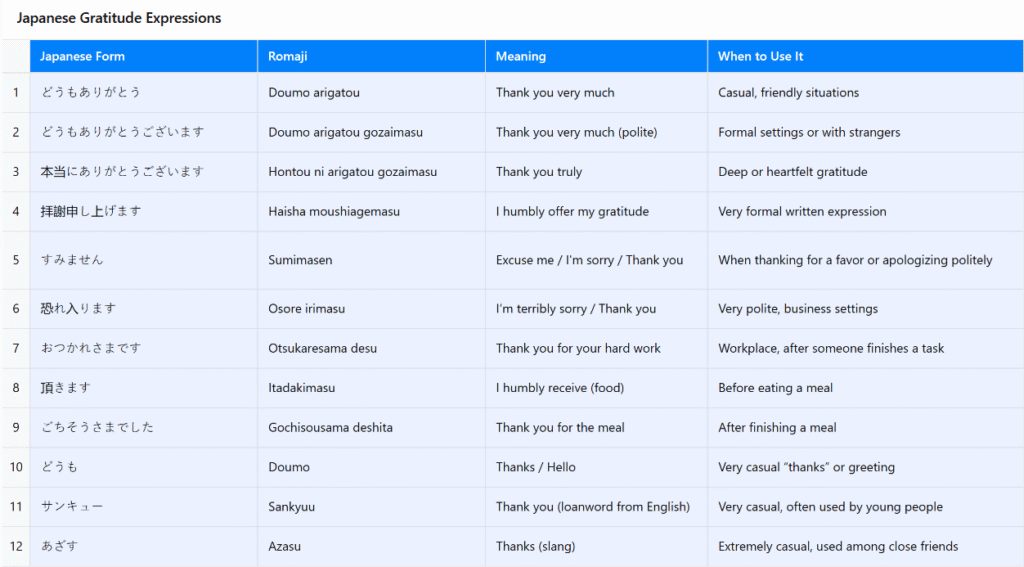
Other Ways to Say “Thank You” in Japanese
Arigato in Japanese Culture
Gratitude in Japan goes beyond words, it’s a core value tied deeply to social harmony. Saying arigato signifies respect, acknowledgement, and connection.
Examples include:
- After a meal: You may say ごちそうさまでした (gochisōsama deshita) and follow it with a sincere “arigato” to the person who prepared or paid for the meal.
- After shopping: Clerks often say ありがとうございました (arigato gozaimashita) as you leave.
- When you receive help: Even small favors are met with genuine gratitude.
[Click here] to learn more about Arigato!
Bowing and Saying Thanks
Bowing is a traditional way to say thanks in Japan and varies by the situation:
- Bow ~15° for a casual thank-you (like greeting a neighbor).
- Bow ~30° in professional or formal scenarios (e.g., greeting a client).
- Bow ~45° for deep thanks, apologies, or showing respect (e.g., significant favors or mistakes).
Traditionally, men bow with arms at their sides, while women may fold hands below the waist.
Gift-Giving as Thanks
In Japan, giving gifts is another powerful way to say thanks:
- お中元 (O-chūgen) – mid-summer gifts
- お歳暮 (O-seibo) – year-end gratitude gifts
These practices show appreciation to teachers, bosses, and family. In daily life, exchanging small return gifts (お返し, okaeshi) after receiving a gift is common! For example, returning containers with something thoughtful inside.
When presenting or receiving a gift, always use both hands and wait to open it until later. And if it’s for a group, it’s considered polite to bring a gift for everyone involved.
When Not to Use Arigato
There are moments when “arigato” isn’t suitable:
- Formal compliments or honors often require a bow or humble response.
- Official documents or formal writing may use 感謝いたします (kansha itashimasu).
- Sincere apologies require other expressions, such as 申し訳ありません (mōshiwake arimasen) or すみません (sumimasen).
Final Thoughts
So, what does “arigato” truly mean? While it may seem simple, this Japanese word for thank you “arigato” carries deep cultural significance. It’s often one of the first expressions learners pick up, embodying a sense of humility, mutual respect, and heartfelt appreciation.
Whether you’re offering a quick “thanks” or saying thank you so much in Japanese, knowing how to use “arigato” properly is key to making meaningful connections.
Mistakes happen, but with practice, you’ll soon be expressing gratitude naturally and confidently in any situation.