
Introducing yourself in Japanese can become a fun and engaging experience. Whether you find yourself in a casual friend group, a school environment, or a formal work setting, this article explores various scenarios in which you might introduce yourself, along with examples and tips to help you shine in any situation.
The Importance of Self-Introduction
In Japan, self-introduction (自己紹介, jikoshoukai) is an essential part of social etiquette. It not only helps break the ice but also sets the stage for future interactions. A well-delivered self-introduction can reflect your personality and respect for Japanese culture, making it crucial to get it right.
Next, let’s look at some situations where you might need to introduce yourself:

Casual Settings with Friends
In casual settings, like meeting new friends through hobbies or social gatherings, your self-introduction doesn’t have to be overly formal. Simply just say:
はじめまして!ジェームズです。よろしくお願いします!
Romaji:
Hajimemashite! Jēmuzu desu. Yoroshiku onegaishimasu!
English:
Nice to meet you! I’m James. Please take care of me!
Tip: In casual groups, it’s better to keep things simple and shorten polite phrases (relaxed tone) to connect with people more easily. Mentioning your hobby or interest in your introduction is also a great icebreaker.
School or Classroom Environment
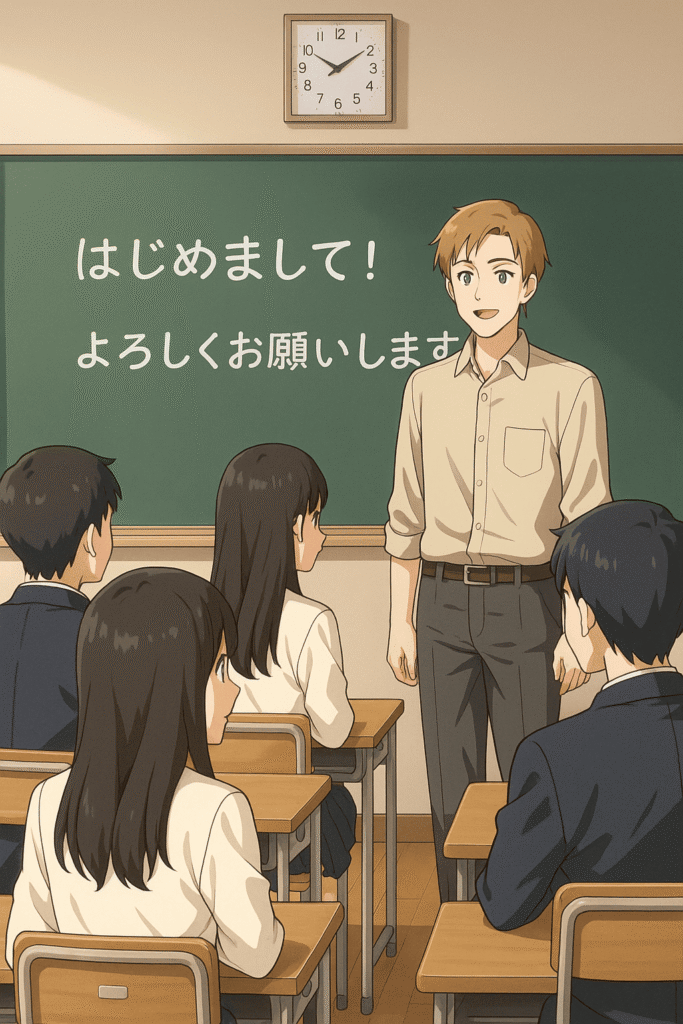
At school or in language classes, a slightly more polite style is expected. Teachers and classmates usually want to know your background, so mentioning where you’re from and what your hobbies are is common. In Japan, when you transfer to a new school, you’re often asked to stand at the front of the class and introduce yourself in Japanese.
Example:
はじめまして。エミリーです。ニュージーランドから来ました。趣味は野球を見ることです。よろしくお願いします。
Romaji:
Hajimemashite. Emirī desu. Nyūjīrando kara kimashita. Shumi wa yakyū o miru koto desu. Yoroshiku onegaishimasu.
English:
Nice to meet you. My name is Emily. I’m from New Zealand. My hobby is watching baseball. Please take care of me.
Tip: In school settings, end with よろしくお願いします (yoroshiku onegaishimasu) to show politeness and willingness to cooperate.

Formal Work Settings
When meeting colleagues, clients, or joining a company, your self-introduction becomes part of your professional identity. Keep it polite, respectful, and concise.
Example:
はじめまして。オリビアと申します。ニュージーランド出身で、ITを専門にしています。本日からよろしくお願いいたします。
Romaji:
Hajimemashite. Oribia to mōshimasu. Nyūjīrando shusshin de, IT o senmon ni shiteimasu. Honjitsu kara yoroshiku onegai itashimasu.
English:
Nice to meet you. My name is Nobu. I’m from New Zealand and I specialize in IT. I look forward to working with you from today.
Tip: Use と申します (to mōshimasu) instead of です (desu) in formal contexts. It shows extra politeness and professionalism.
Self-Introduction Template
はじめまして。
Hajimemashite.
“Nice to meet you.”

わたしは [Your Name] です。
Watashi wa [Your Name] desu.
“I am [Your Name].”
Tip: You can also drop “watashi wa” in casual settings: [Your Name] desu.
[Country / City] から来ました。
[Country / City] kara kimashita.
“I’m from [Country / City].”
しゅみは [Hobby] です。
Shumi wa [Hobby] desu.
“My hobby is [Hobby].”
Tip: Great way to give people a topic to connect with you.
よろしくお願いします。
Yoroshiku onegaishimasu.
“Please take care of me / I look forward to working with you.”
Tip: A cultural set phrase to end your introduction politely.


Click above to download this handy template on how to introduce yourself in Japanese across three common situations. See below for what information you can add into the [options]:
- Replace [Name] with your name.
- Replace [Country] with your origin.
- Replace [Hobby] with something like サッカー (soccer), アニメ (anime), or 音楽 (music).
- Replace [Specialty/Field] with IT, teaching, marketing, etc.
Japanese Cultural Tips
- Body Language Matters – A small bow adds respect when meeting someone for the first time.
- Politeness Level – Use です/ます forms in most situations unless you’re with close friends.
- Keep It Simple – Don’t overcomplicate. Japanese self-introductions are usually brief.
- Add a Hobby or Interest – This often sparks conversation and helps people remember you.
- Practice – Try rehearsing your self-introduction out loud so it feels natural.
Common Mistakes to Avoid
- Forgetting “Hajimemashite”: Jumping straight into your name may feel abrupt.
- Speaking too fast: Slow down, especially with your name, so others can catch it.
- Mixing casual and formal: Stick to one style depending on the situation.
Introducing yourself in Japanese may feel intimidating at first, but it’s actually a fun way to practice both language and culture. By learning a few simple phrases and adjusting your tone for casual, school, or work settings, you can confidently handle self-introductions anywhere in Japan.
Remember: Consistency and practice are key.
Try using your self-introduction with Japanese friends, in class, or even when practicing alone. Over time, it will feel natural, and you’ll become confident in introducing yourself in Japanese.